The UAE is the universal hub for camel research. Our organisation works closely with camel owners, trainers, and the Dubai Camel Racing Club, as they regularly test camels for their paternity as well as for doping.” – Ulrich Wernery, scientific director, Central Veterinary Research Laboratory
Get set, ready…grab onto your seats, and watch the camels go! From royals to rural folk, camel racing in the UAE is an essential element of national culture that’s loved by all Emiratis. Today, it is also a booming business that draws in crowds from around the country and the world. In fact, these events are among the best opportunities in the country to experience an authentic Emirati tradition while mingling with locals, expats, and international visitors.
Delve into this sporting niche and you’ll soon realise there is an intricate method, even an esoteric science behind the on-track mayhem of race day – the Emirates Camel Racing Federation makes stringent camel racing policies while various regional centres are involved in genetically enhancing breeds of superfast dromedaries. And there’s much more to a camel than meets the eye; read on to find out about female empowerment in the world of these showrunners!
Come winter months and it’s a camel extravaganza – there’s a whole lot more buzz about different camel festivals that are often hosted and named after various UAE rulers. Apart from the races, you can indulge in various camel – centric eccentricities here – think beauty
pageants and camel polo! Mahaliyat, Asayel, Muhajanat, and ‘purebreds, ‘interbreds’ or ‘firstborns’ – hang about the camel hippodromes or auctions for a while and you’ll hear these words thrown around in reference to the most coveted racers.
Don’t worry if you missed the Sheikh Hamdan bin Mohammed bin Rashid Al Maktoum Camel Race Festival in February – you’re right in time to straddle into the Al Marmoum Heritage Festival. Come ready to be dazzled; amidst the rising dust and flailing lean legs of camels, there’s plenty of glitz to go around with modern sporting embellishments and luxury wins up for grabs. Are you race ready?
A friend in the desert
There’s more to celebrating camels than the races. Emirati heritage galas such as the Al Dhafra Camel Festival proudly showcase such splendours as camel beauty pageants and auctions. As a single camel can fetch well over Dh1 million, contests are taken pretty seriously; the pageant alone presents 50 different competitive categories. No doubt, events with such high stakes pose hurdles and humps of their own; earlier this year, 12 camels were disqualified from a camel beauty competition in Saudi Arabia as owners were found guilty of injecting botox into the animals’ pouts for cosmetic enhancements! It’s not all money, though; for a quirky Arabian spin on a conventional game, try camel polo – the UAE’s most offbeat sport. Similar to its equestrian counterpart, a goal is scored when the player hits the ball or the camel kicks it towards the goal post. This is a good one to try if you’re turning 16 – the age requirement for the activity.
You’re still good to go without any prior training as a thorough briefing is included in pre-game routines.
Across sands of time
To a Bedouin, a camel is more than a loyal pet. Over the centuries, tribes across Arabia owe their survival in part to their herds of camels. Used for transportation, milk, meat, hides or as high value assets, camels have been involved in the everyday customs of desert dwellers. Camel racing has always been a thing, albeit in a very different form from the phenomenon it is today. Sprinting astride a camel was more of an impromptu undertaking enjoyed at social gatherings; during the late 20th century, it grew as an organised sport in Africa, the Middle East, India, and Australia.
In the UAE, camel racing became a priority soon after the nation’s union. Today, the UAE is a leading hub for global camel racing events, regulations, and research. The sport has undergone a massive makeover in the past few decades – from presenting the winning jockey with a small gift (usually food) to now being an internationally-renowned experience that could feature week-long festivities and over 15,000 competing, selectively-bred camels.
Raised for the races
What does it take to get a camel ready for the races? As camel racing has amassed global popularity and value, the UAE has established itself as a premier centre for advancements in the breeding and training of these sure-footed dune dashers. The Veterinary Research Centre (VRC) in Sweihan, Abu Dhabi works on a commercial basis to produce an elite racing lineage using scientific methods like embryo transfers and artificial insemination.
Similarly, the Camel Reproduction Centre in Dubai is at the forefront of research in its field – in 2009, they successfully cloned the world’s first camel, Injaz, and continue to explore ways to enhance desirable sporting traits in runners. This is just the start. From employing
Bedouin tribesmen adept in the art of grooming camel babies into speedy track stars to regimenting diets and conducting specialised treadmill and swimming pool trainings for camels, the UAE is heavily invested in raising powerful, pristine, and race-ready camels.
UAE’s take on the game
While races take place throughout the year, racing season runs from October to April.
Games are usually held on weekends, although there is no set schedule.
There are approximately 15 racetracks spread across the country. Dubai’s Al Marmoom Racetrack is the largest and most popular.
Winners compete for luxury cars, cash prizes (totalling up to Dh80 million), and trophies.
Winning camels are typically bought over by members of the royal family.
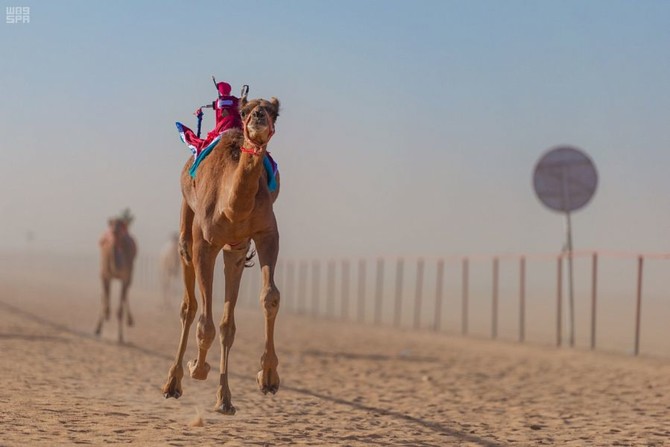
In 2002, the UAE became the first country to impose a ban on underage riders. Using robot jockeys is the new norm; they are remote-controlled by trainers who drive alongside the tracks in 4x4s.
The UAE currently has over 14,000 active racing camels.
The A-Z of a typical day at the racecourse
It’s a bright and early start – the morning session races take place between 7.30am and 9.00am.
There are also afternoon sessions commencing at 2.30pm.
A single race may feature between 15 – 60 camels, costumed in multi-coloured garbs and competing in 4 km to 10 km distances.
General admission is free and visitors can watch about two races a day.
Spectators today enjoy modern comforts at the tracks, such as grandstands and giant screens for live broadcasts. Nonetheless, a pair of binoculars is a common accessory to bring along.
Unlike at the horse races, there’s no compulsion to dress to impress. Camel lovers are content to spectate in casual attire.
Fast facts to know
The species originated in North America. The first known camel genus, named ‘Protylopus’, was about the size of a rabbit.
A camel’s hump doesn’t hold water; rather, it stores fatty tissue, allowing the animal to easily adapt to drastic climates and temperatures.
There are two primary camel species today – the dromedary (or Arabian camel) with one hump, and the Bactrian which has two humps.
Camels can run at speeds of up to 65 km/h for short stints or 40 km/h for long distances.
A calf under two years old is not allowed to race as its body is still developing.
Racing is usually limited to dromedaries (which originates from the Greek word ‘dromas’, meaning ‘runner’).
Females are preferred track stars, and have longer careers than the usual 2-3 race years of a male.
Herding for the win: The experts have their say
The Central Veterinary Research Laboratory (CVRL) regularly tests male and female camels for infectious diseases, prior to breeding and there are other centres in Dubai, which perform artificial insemination, embryo transfer and even cloning. The UAE is the universal hub for camel research. Our organisation works closely with camel owners, trainers, and the Dubai Camel Racing Club, as they regularly test camels for their paternity as well as for doping. We have a doping control unit at the Marmoom Race Track.
– Ulrich Wernery, scientific director, Central Veterinary Research Laboratory
Watching the races is always pleasant as you can see the excitement and passion of the people involved. Crowd engagement is awesome; many cheer for the camels that they support while some spend the whole time trying to get a good picture with a camel in the background. At a recent race, tourists were shuttled in buses moving adjacent to the tracks for a close-up race experience. They were ecstatic to say the least. Most spectators are dressed in casual and comfortable wear; although we expect the fashion quotient to rise soon akin to the horse races.